 how-to
How to Pack Fragile Items for a Safe Move
Table of Contents
- What You'll Need to Pack Fragile Items
- The Best Packing Materials for Fragile Items
- How to Pack Dishes for Moving
- Step-by-Step Guide: How to Pack Fragile Items
- Packing Fragile Items for Shipping
- Common Packing Mistakes and How to Avoid Them
- Conclusion
- Frequently Asked Questions
Last Updated: September 6, 2026
Packing fragile items for a move comes down to one principle: movement is the enemy. If an object can shift, slide, or collide inside its box, it will break. The fix is protective layering that absorbs shock and eliminates empty space. At Wolfe Moving, we've packed thousands of households across Frederick and Hagerstown, and this guide walks through the exact methods our crews use to pack fragile items safely, whether you're moving across town or across state lines.
What You'll Need to Pack Fragile Items
Before you wrap a single plate, gather your supplies. Having everything on hand prevents the temptation to "just use a towel" mid-pack, which is how glassware gets crushed. The core supplies are: sturdy corrugated cardboard boxes in several sizes, packing paper (not newspaper, which smudges), bubble wrap, packing tape, and a marker for labeling.
You will also need void fill material such as packing peanuts or air-cellular cushioning to fill gaps. Box reinforcement tape is worth the extra cost; standard household tape fails under the weight of heavy breakables. A common mistake is using boxes that are too large. A packed box should be heavy enough to feel solid but light enough to lift without strain. If you can hear contents shifting when you tilt the box, it is not ready for transit.
The Best Packing Materials for Fragile Items
The right material depends on the item's fragility, weight, and the distance it's traveling. Here’s a breakdown of what professionals use and why, so you can make informed choices without overspending.
Packing Paper is the workhorse for most items. It's pliable, provides a good friction fit, and is excellent for wrapping dishes, glasses, and filling voids. Use unprinted, acid-free paper to prevent ink smudging on your belongings. A 24-inch by 36-inch sheet is a standard size that offers good coverage (osha.gov). For heavy items like stoneware, consider double-wrapping with paper for added abrasion resistance.
Bubble Wrap is your primary defense against impact. The key differentiator is bubble size. Small bubbles (1/4 inch) are for delicate items with fine details, like porcelain figurines or electronics, as they conform to intricate shapes. Large bubbles (1/2 inch to 1 inch) are better for creating a cushioning layer around larger, more robust items like framed mirrors or lamps. When wrapping, use at least two full layers and secure the ends with tape, not by crushing the bubbles.
Foam Rolls and Sheets are the premium choice for high-value items like artwork, flat-screen TVs, and large glass table tops. Polyethylene foam, often 1/4-inch or 1/2-inch thick, offers superior shock absorption compared to paper or bubble wrap. It does not scratch polished surfaces and provides a rigid, protective barrier. While more expensive, the cost is justified for items that are irreplaceable or costly to repair.
Void Fill is what prevents items from shifting during transit. The two main options are:
- Packing Peanuts: These are effective and lightweight, but they can settle during a move, leaving gaps. If you use them, fill the box completely and shake it gently to settle the peanuts before adding more. Note that standard polystyrene peanuts are not eco-friendly; look for starch-based, biodegradable alternatives if this is a concern.
- Air Pillows (Air-Cellular Cushioning): These are the modern standard for many professional movers. They don't settle, provide excellent cushioning, and take up less storage space than peanuts. They are also more expensive but offer a better, more reliable fit for irregularly shaped items.
A Note on Boxes: The material of the box is as important as what's inside. A single-wall corrugated box is fine for light items like linens. For fragile items, especially those over 20 pounds, a double-wall corrugated box is essential (the FDA). The 'double-wall' refers to two layers of corrugated medium, providing significantly more crush resistance. Check the box's edge crush test (ECT) rating; a rating of 32 or higher is a good benchmark for moving heavy or fragile goods.
The Trade-Off: There is no single 'best' material. A common professional approach is to use a combination: wrap the item in paper to protect its surface, then add a layer of bubble wrap for impact resistance, and finally, use foam or air pillows for void fill. This layered approach provides a defense-in-depth that a single material cannot match.
How to Pack Dishes for Moving
Packing dishes is the most common fragile-item task, and most damage happens because plates are stacked flat. The correct method is to wrap each dish individually and place it vertically, like records in a crate. Start by laying a sheet of packing paper flat, placing the dish in the center, and folding the corners over the plate. Add a second sheet for extra cushioning, then tape the bundle closed.
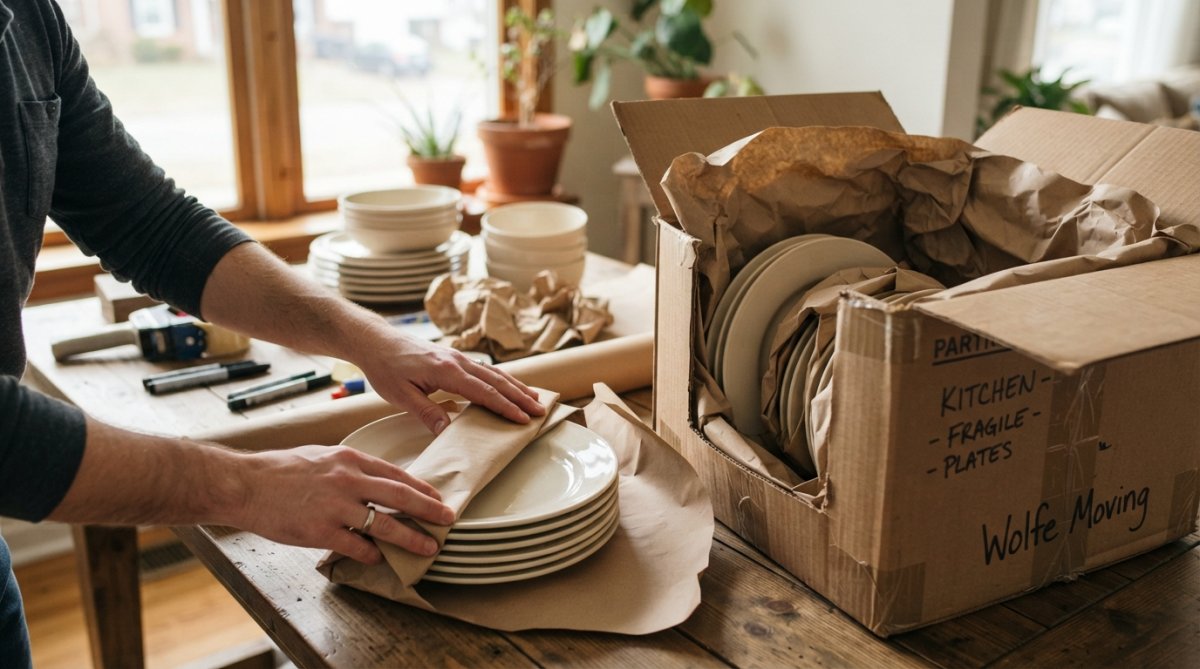
Line the bottom of the box with crumpled packing paper for shock absorption. Stand the wrapped plates vertically, side by side, with the edges facing down. This distributes weight along the strongest part of the dish. Glasses and mugs go on top, stuffed with crumpled paper to prevent internal stress. Bowls nest in pairs with a sheet of paper between them. Never stack flat plates horizontally in a moving box; the weight of the stack concentrates on the bottom plate, and one sharp jolt causes a crack.
Step-by-Step Guide: How to Pack Fragile Items
This is the core process. Follow these steps in order to create a box that can survive the rigors of a move. The goal is to eliminate all movement and distribute force away from the fragile object.
-
Choose the right box. This is a critical decision. For heavy items like dishes, books, or stoneware, use a small or medium box (no larger than 18" x 18" x 16"). A fully packed box of dishes can easily weigh 40-50 pounds. A larger box would become too heavy to lift safely and would likely fail. Reserve large boxes for light, bulky items such as pillows, comforters, and lampshades. A good rule of thumb: the heavier the item, the smaller the box.
-
Reinforce the bottom. The bottom of the box carries the entire load. Do not rely on the manufacturer's single strip of glue. Use a high-quality, 2-inch wide packing tape (not duct tape or masking tape) to reinforce the bottom. Apply an H-pattern: one strip across the center seam, and two strips along the edges where the flaps meet the box walls. This creates a strong, load-bearing base.
-
Create a shock-absorbing base layer. Crumple 3 to 4 inches of packing paper and place it at the bottom of the box. This acts as a first line of defense against impacts from below. Do not use a single flat sheet; crumpled paper creates air pockets that absorb energy.
-
Wrap each item individually. This is non-negotiable. Never place two fragile items in direct contact. Wrap each item in packing paper, then a layer of bubble wrap for added protection. Pay special attention to the most vulnerable parts: the corners of picture frames, the handles of mugs, and the rims of glasses. Secure the wrapping with tape, but do not overtighten, as this can create pressure points.
-
Pack from the bottom up, heaviest first. Place the heaviest, most robust items at the bottom of the box. Lighter, more delicate items go on top. This lowers the box's center of gravity, making it less likely to tip over in the truck. A box with a high center of gravity is unstable and prone to falling, which is a leading cause of damage.
-
Fill every void. This is the most common mistake. After placing a few items, fill any gaps with crumpled paper, packing peanuts, or air pillows. The contents should be so snug that you cannot feel any movement when you gently shake the box. If you can feel shifting, it will break in transit. Fill the box to the top, leaving just enough room to close the flaps without crushing the contents.
-
Seal and label. Close the box and press down firmly. Tape the top with the same H-pattern you used on the bottom. Then, label the box clearly. Write "FRAGILE" on all four sides and the top. This ensures the label is visible no matter how the box is stacked. Also, write the destination room (e.g., "Kitchen") and a brief description of the contents (e.g., "Dishes - China"). This is crucial for both the movers and for your own inventory.
The Physics of a Well-Packed Box: The principle behind all these steps is to manage kinetic energy. When a box is dropped, the energy of the impact travels through the box. Your packing materials, the crumpled paper, bubble wrap, and void fill, act as shock absorbers, converting that kinetic energy into a slower, more controlled compression. This gives the fragile item time to decelerate gently, rather than experiencing a sudden, sharp impact. By keeping the center of gravity low and the contents immobile, you ensure that the force of any impact is distributed across the entire box and its cushioning, not concentrated on a single point of contact with a fragile item. This is why a box that is completely full and properly cushioned will survive a drop that would shatter an item in a half-empty box.
Packing Fragile Items for Shipping
Packing fragile items for shipping introduces different risks than moving them yourself. Your boxes will be handled by multiple people and machines, so the margin for error shrinks. Double-boxing becomes essential for anything valued over a few hundred dollars. The outer box should be at least 2 inches larger on all sides than the inner box, with the gap filled entirely with packing peanuts or air-cellular cushioning.
For shipping, use a new, double-walled corrugated cardboard box whenever possible. Used boxes lose structural integrity, especially if they show signs of crushing or moisture damage. Moisture protection matters during long-distance transit; wrap electronics and items sensitive to humidity in plastic sheeting before adding cushioning. Attach fragile labels to every side of the box and write "THIS SIDE UP" where orientation matters. Consider purchasing shipping insurance for high-value items. Document the condition of each item with photos before sealing the box; this documentation is your evidence if you need to file a claim. According to United States Postal Service guidelines on packing and shipping, proper cushioning and box selection are the primary factors in preventing transit damage.
Common Packing Mistakes and How to Avoid Them
Most breakage traces back to a handful of predictable errors. The first is under-filling boxes. A box that is only half full allows contents to shift and collide. The second is over-filling, which prevents the box from closing properly and puts pressure on the contents.
Another frequent mistake is using the wrong tape. Masking tape and duct tape do not hold up during a move; they peel off in temperature changes and leave boxes gaping open. Use a quality packing tape and apply it in an H-pattern on both the top and bottom of the box. A third error is ignoring weight limits. A large box filled with books or dishes can exceed 50 pounds, making it dangerous to lift and prone to bottoming out. If a box feels too heavy, split the contents into two smaller boxes.
| Mistake | Why It Breaks Items | The Fix |
|---|---|---|
| Flat-stacking plates | Weight concentrates on bottom plate | Pack dishes vertically on edge |
| Under-filled boxes | Contents shift and collide | Fill all voids with cushioning |
| Oversized boxes | Contents slide during transit | Use the smallest box that fits |
| Weak tape | Boxes burst open under load | Use reinforced packing tape, H-pattern |
| Skipping double-boxing | Single wall fails on impact | Double-box high-value items |
Conclusion
Properly packing fragile items is not complicated, but it requires discipline. Wrap every item individually, choose the right box size, fill every void, and reinforce every seam. These steps protect your belongings and give you peace of mind on moving day. For those who prefer to leave it to the professionals, Wolfe Moving brings over 30 years of experience in secure transport of delicate and heavy items, using specialized equipment and precision handling for pianos, antiques, and full households. Get an estimate today and let our team handle the fragile work for you.
Frequently Asked Questions
Should I use bubble wrap or packing paper for fragile items?
Use both, but for different purposes. Packing paper is ideal for wrapping dishes, glassware, and other items with flat surfaces because it conforms well and prevents scratches. Bubble wrap provides superior cushioning and shock absorption for oddly shaped items, electronics, and particularly delicate objects. A good strategy is to wrap items first in packing paper and then add a layer of bubble wrap for items that are especially fragile or valuable.
Is USPS or UPS better for shipping fragile packages?
The best carrier depends on the size, weight, and destination of your package. For smaller, lighter items, USPS Priority Mail can be cost-effective. For larger or heavier packages, UPS or FedEx Ground often provides better rates. Regardless of the carrier, the most important factor is how well you pack the item. Proper cushioning, double-boxing, and clear fragile labels are what truly ensure your items arrive safely.
How do I pack fragile items for a long-distance move?
Long-distance moves require extra care. Use sturdy, corrugated cardboard boxes. Wrap each item individually, and use a generous amount of cushioning material, like packing peanuts or air-cellular cushioning, to fill all voids. Consider double-boxing your most valuable items. Finally, label each box clearly as 'FRAGILE' on all sides and note which room it belongs in. This helps you and the movers handle them with care.
What is the best way to pack glassware and ceramics?
Start by lining the bottom of a sturdy box with crumpled packing paper. Wrap each glass or ceramic piece individually in packing paper, paying special attention to stems and handles. Secure the wrap with tape. Place items upright in the box, not on their sides, and pack them tightly together so they don't shift. Fill any empty spaces with more paper or void fill to stabilize the contents.